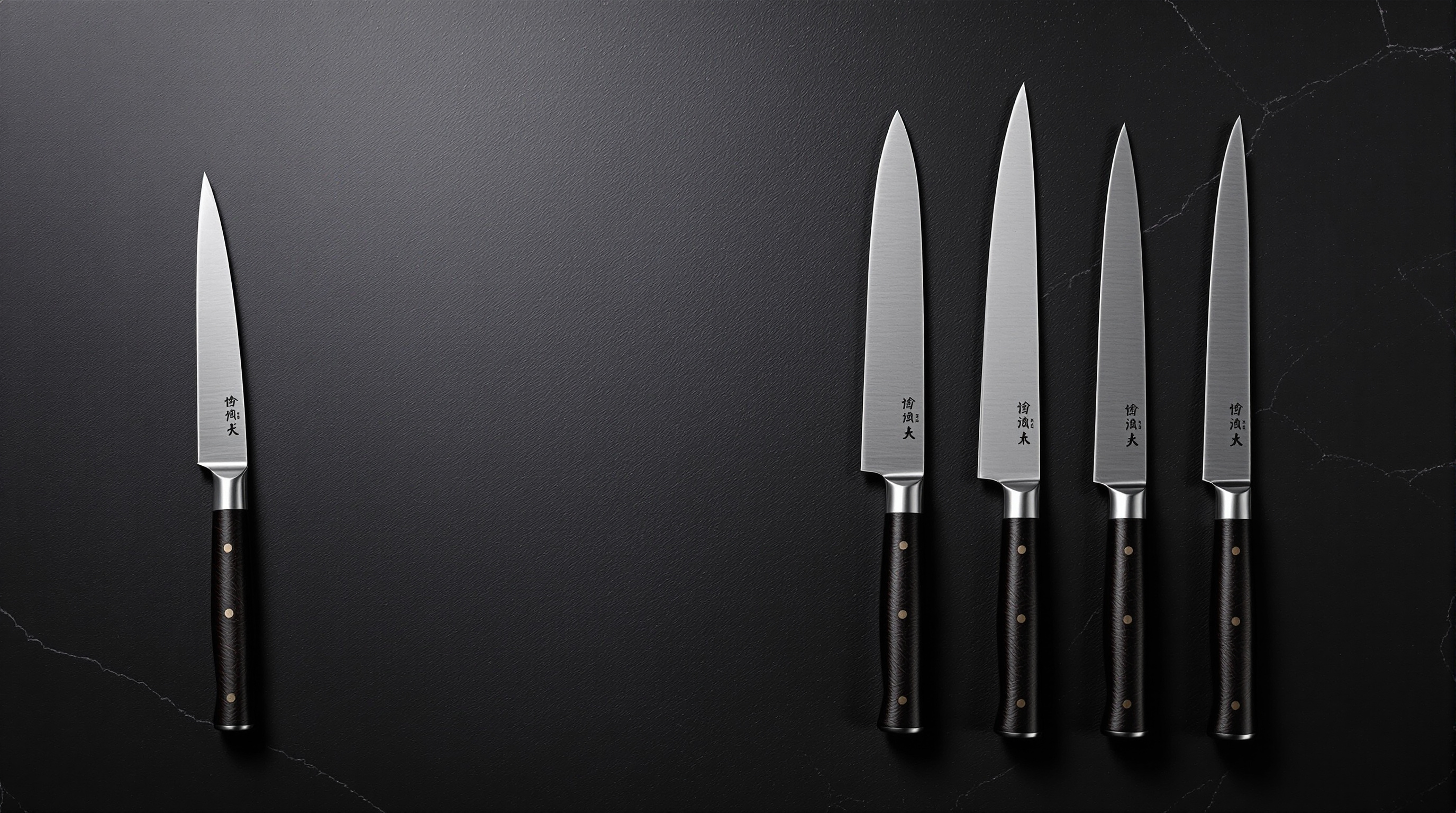
Japanese knives are renowned for their quality. Their light construction, hard steels and elegant designs have won over cooks worldwide, and the country’s centuries-old blade-making traditions produce tools with a genuinely different feel. This guide explains what sets Japanese knives apart and how to choose one that suits you — without pushing any particular brand.
What Makes Japanese Knives Different
Japanese blades tend to follow a lightweight philosophy. Compared with heavier Western knives — which prize heft, a full tang and a large bolster — Japanese knives are usually thinner, lighter and made from harder steel. That harder steel takes a more acute, keener edge and holds it longer, at the cost of being a little more brittle and needing more careful handling. Many are ground with a steeper, more precise edge angle, and some traditional styles are single-bevel (sharpened on one side only) for exceptionally clean cuts.
The Main Types of Japanese Knife
- Gyuto — the Japanese take on the Western chef’s knife: a versatile all-rounder, lighter and thinner than its German cousin. A great first Japanese knife.
- Santoku — a shorter, flatter all-purpose blade (“three virtues”: slicing, dicing, mincing) that suits a push-cutting style.
- Nakiri — a straight, rectangular vegetable knife that chops cleanly straight down to the board.
- Sujihiki — a long, slim slicer for carving meat and fish.
- Yanagiba — a long single-bevel knife for slicing sashimi and sushi; see our dedicated sushi knife guide.
- Petty — a small utility knife for detail work.
Steel, Bevel and Handle
Japan produces many of its own steels, from reactive high-carbon blends prized by professionals to stainless and stainless-clad options that resist rust and need less babying. Home cooks are often happiest with a hard stainless or stainless-clad blade: most of the sharpness, far less maintenance. Consider the bevel too — a double-bevel (V-edge) knife is easier for beginners than a single-bevel blade, and single-bevel knives are ground for right- or left-handed use. Handles come in two families: the traditional Japanese wa handle (light, often octagonal) and the Western-style yo handle (heavier, riveted).
How to Choose
Start with how you cook. If you want one do-everything blade, a gyuto or santoku is the natural choice. Prep a lot of vegetables? Add a nakiri. Slice a lot of proteins? A sujihiki earns its place. Hold a knife before buying if you can — balance and grip comfort matter more than the spec sheet. And be honest about maintenance: reactive carbon steel rewards you with incredible edges but demands prompt drying and occasional care, while stainless is more forgiving.
Edge Angles and Sharpening
Part of what makes Japanese knives feel so sharp is the edge angle. Where a Western knife is often ground around 20 degrees per side, many Japanese blades are sharpened to 15 degrees or less, producing a thinner, keener edge that glides rather than pushes. That precision comes with a catch: a fine edge on hard steel is more prone to chipping if you hit bone or a hard board, and it is best maintained on whetstones rather than a pull-through sharpener, which is ground for wider Western angles. A little practice on a 1000-grit stone, finished on a higher grit, keeps a Japanese blade singing.
Reading the Hardness Number
Japanese knives are usually sold with a hardness figure attached — 60 HRC, 62 HRC, sometimes higher. That is the Rockwell C scale, a standardised measurement of how far a diamond indenter sinks into the steel under a fixed load; the test method is defined by ASTM International, which is why a number from one maker can be compared with a number from another. Western kitchen knives typically sit around 56–58 HRC, most Japanese blades land between 60 and 63, and a few specialist steels go higher still.
What the number actually tells you is the trade-off you are buying. Harder steel holds a fine edge for longer and can be ground thinner without folding over — which is where that startling first-cut sharpness comes from. It is also less forgiving: hardness and toughness pull against each other, so a 63 HRC edge that meets a bone, a frozen edge or a granite worktop is more likely to chip than to roll, and a chip needs stone work to remove rather than a few passes on a honing rod. None of this makes a hard blade fragile in normal use. It simply means the knife assumes you will cut on wood, avoid bones, and sharpen it yourself. If any of those assumptions do not hold in your kitchen, a slightly softer blade will serve you better and you will not miss the difference.
Buying Tips
- Start with one versatile knife — a gyuto or santoku — before building a collection.
- Choose stainless or stainless-clad for your first Japanese knife unless you are ready to care for reactive carbon steel.
- Check the bevel — double-bevel is easier for most cooks; only buy single-bevel if you will learn to sharpen it.
- Handle it first if you can — balance and grip comfort matter more than the spec sheet.
- Match your board — plan to use end-grain wood or soft composite to protect that fine edge.
Caring for a Japanese Knife
Hard, thin edges do not like abuse. Keep your knife off glass and stone boards — use wood or soft composite. Never put it in the dishwasher, dry it immediately, and store it protected. Hone gently and sharpen on whetstones at the blade’s intended angle. Treated well, a good Japanese knife can last a lifetime. For the fundamentals of steel and edge care, see our helpful guide to kitchen knives.